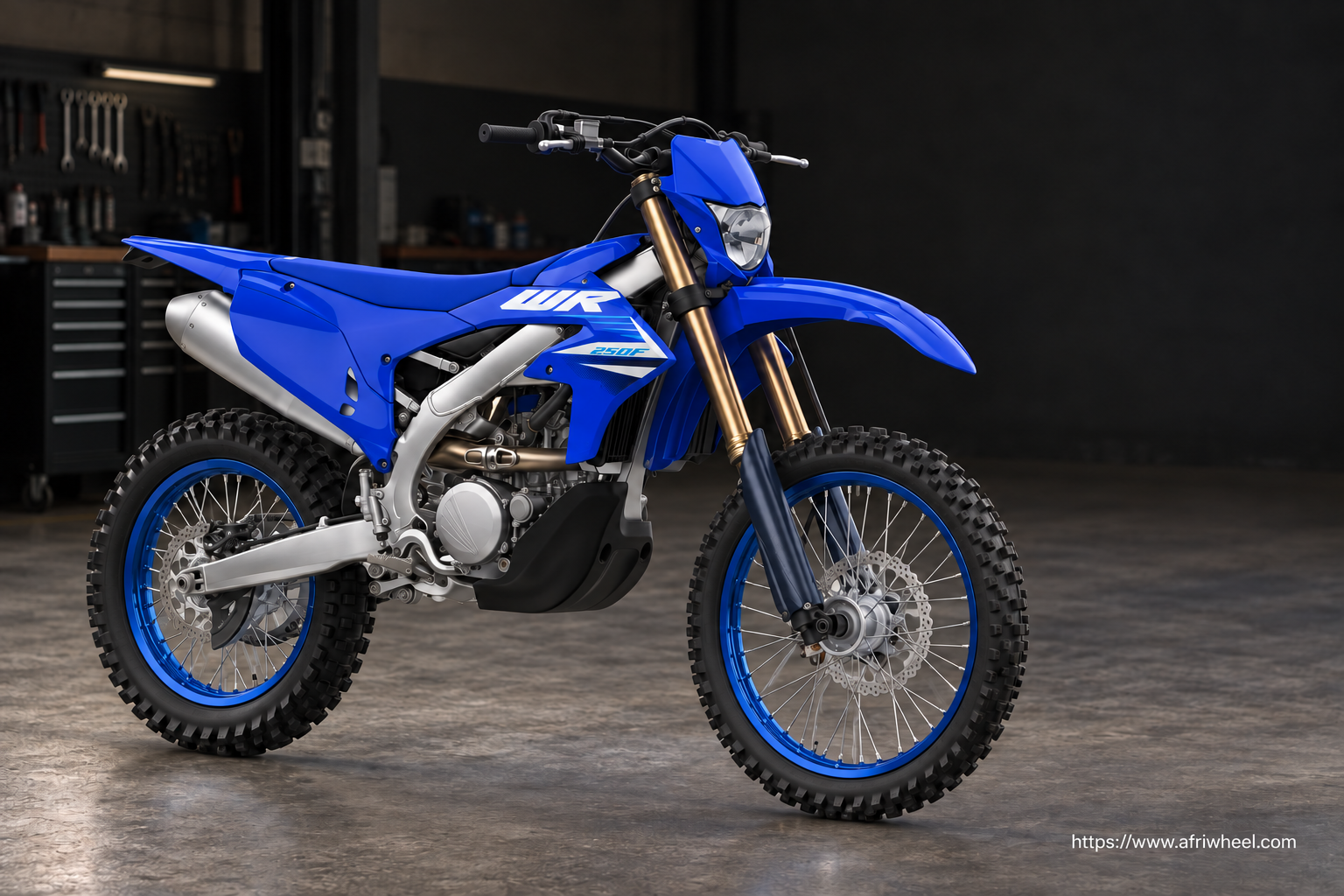
WR250F buyer overview
The central reason to consider the WR250F is its defined place as a enduro motorcycle for the 2025 model year. Yamaha's locally reviewed material supports a range made up of WR250F; colour choices are not treated as extra mechanical variants. It is designed around technical enduro riders wanting a compact 250-class four-stroke competition platform. It makes less sense for road commuting, low-maintenance farm transport or riders not prepared for competition servicing. That buyer-first framing matters because two machines with similar engine capacities can demand very different skills, ownership budgets and legal use conditions.
Looking past the bodywork, the WR250F is defined by engine capacity 250 cc, engine cycle 4-stroke, and cooling Liquid-cooled. Its delivery hardware is represented by transmission 6 Speed Multiplate Wet Clutch, gear count 6, clutch Multiplate Wet Clutch, final drive Chain, and fuel capacity 7.6 litres. The relationship between those facts matters: engine configuration influences packaging and feel, while transmission type changes workload and use. AfriWheel does not convert that relationship into invented speed or economy claims. Owners should use the figures as shortlist filters, then confirm starting, warm-up, fuel, lubricant and service instructions from the exact document associated with the delivered model year and derivative.
Physical fit is described by wheelbase 1,471 mm, seat height 955 mm, and kerb weight 112.9 kg. Each dimension answers a different question. Seat height is only a starting point for reach because seat width, suspension sag, boots and rider proportions all alter feet-down confidence. Wheelbase and overall size help with transport, storage and manoeuvring, but they cannot predict steering feel on their own. Mass needs its published definition: dry and kerb figures are not interchangeable. Anyone loading the WR250F onto a trailer, rack or workshop stand should use the exact measured vehicle and the carrier's rated capacity rather than relying solely on a rounded catalogue number.
Underneath the WR250F, confirmed chassis information includes front suspension KYB spring-type fork with speed sensitive damping fully adjustable 11.8-in travel, front suspension travel 299.72 mm, rear suspension KYB single shock fully adjustable 12.0-in travel, and rear suspension travel 304.8 mm. The stopping package is front brake Hydraulic disc, front disc diameter 270 mm, rear brake Hydraulic disc, rear disc diameter 240 mm, and traction control Electronic traction control; rolling dimensions are front wheel diameter 21 inches, rear wheel diameter 18 inches, front tyre 80/100-21 Dunlop® Geomax MX33F, and rear tyre 110/100-18 Dunlop® Geomax MX33. This hardware helps distinguish its intended environment but cannot be converted into an unverified handling score. Suspension settings may need to change for rider mass, passenger, luggage or competition conditions. ABS or traction control, when explicitly listed, supports rather than replaces technique and grip. Buyers should confirm whether tyres are tube-type or tubeless, which sizes and ratings are approved, and whether the delivered brake components match the exact model-year parts documentation.
The reviewed WR250F record does not provide a road-style convenience list; buyer fields such as ABS, instrument display, phone and navigation support, and under-seat storage therefore remain unclaimed. That is appropriate context for a competition machine, where setup and operating controls matter more than connectivity. Handover should cover the kill switch, starting and stopping procedure, fuel system, air-filter access, chain adjustment, suspension baseline and every control actually fitted. Event-specific lighting, protection or navigation must be documented as separate equipment instead of assumed standard.
Cross-country suitability for WR250F depends on terrain duration, rider pace, fuel planning and the ability to maintain a competition machine away from a workshop. An 18-inch rear wheel, wide-ratio gearbox or extra fuel capacity can be meaningful when documented, but none should be assumed from the family name. Buyers need to confirm event eligibility, public-road restrictions, protection hardware, spares, suspension setup and service intervals in the exact manual before treating it as a ready-made trail or race solution.
There is one mapped derivative, WR250F, so the model decision is mainly about suitability, colour, dealer terms and any accessories rather than a trim ladder. No exact current South African amount is published in the reviewed record for WR250F. Treat any informal or foreign-market figure as non-comparable and obtain a dated written quotation for the exact product. A useful comparison sheet should put the exact derivative name, model year, transmission, standard equipment, colour, warranty, service requirements and all fees on one line. That prevents an attractive monthly repayment from hiding a longer term, deposit, balloon payment or excluded cost. It also prevents a discounted older unit from being mistaken for the current specification. A written quotation should identify any optional accessories separately and say whether fitment changes warranty, mass, dimensions or intended use.
Some commonly requested details are not safely published for the WR250F. In the principal buyer groups, the absent fields include cylinder layout, maximum power, power peak, maximum torque, torque peak, claimed fuel consumption, overall length, and overall width. Those blanks should be handled as questions for Yamaha or an authorised dealer, never as zero values or evidence that equipment is absent. They also should not be filled from a similarly named US, European or Australian model unless Yamaha documents exact equivalence. The locally mapped use statement is not stated in the reviewed material. Warranty duration, service intervals, payload, towing, emission or noise values require their own exact South African evidence before they can influence an ownership score.
The WR250F's distinct decision point is its 250-class four-stroke enduro brief rather than motocross sprinting or road transport. Its six-speed wet-clutch transmission, 7.6-litre tank, 1,471 mm wheelbase and 955 mm seat are relevant to long technical sections where gear choice, range planning and standing control matter. The mapped kerb mass is 112.9 kg. KYB suspension travel is approximately 300 mm at the front and 305 mm at the rear, matched to 270/240 mm hydraulic discs and a 21-inch front with an 18-inch rear. Electronic traction control is documented, but the rider still has to read terrain, select appropriate tyres and maintain momentum. There is no accepted current vehicle price in the package, so value cannot be inferred from a related YZ or WR450F listing. A prospective owner should ask an authorised seller about exact availability, competition setup, spares and pre-delivery work, then obtain the WR250F manual before planning service. The machine makes most sense for a trained rider who wants the lighter-demand feel of a 250-class enduro platform and can support race-oriented maintenance between events.
Taken as a whole, the WR250F makes the strongest case for technical enduro riders wanting a compact 250-class four-stroke competition platform. It should move down the list for road commuting, low-maintenance farm transport or riders not prepared for competition servicing. The final decision should follow a physical fit check, a representative test or supervised evaluation where permitted, an insurance or transport plan, and a written quote for the exact derivative. Compare only confirmed like-for-like facts, then let personal fit and operating context decide between otherwise credible choices. That approach keeps the model's real strengths visible without turning an incomplete brochure field into a marketing promise.