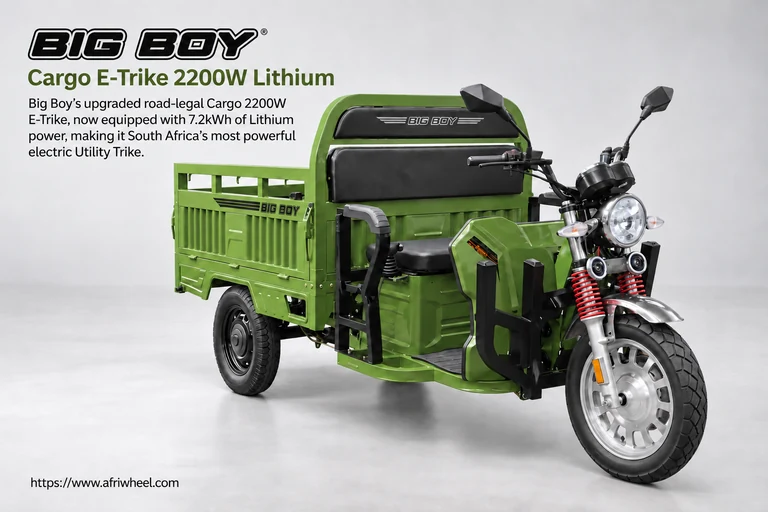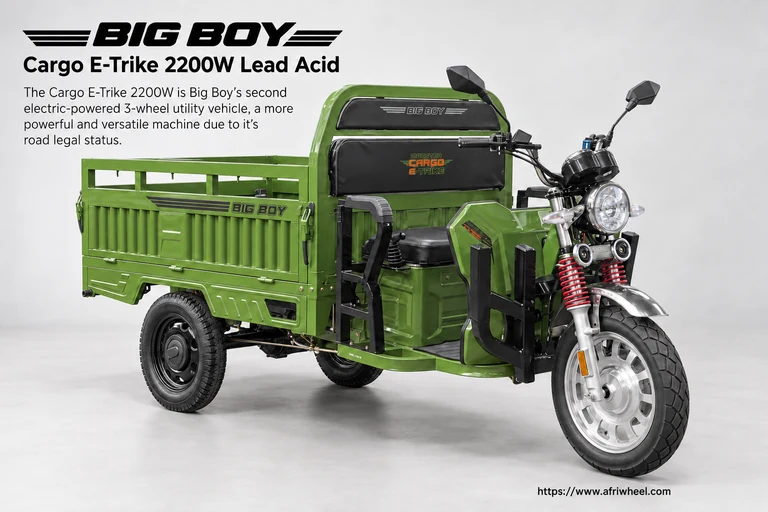
Monster Eco-Hauler 2000W 4×2 — current South African listing buyer overview
The exact derivative here is Monster Eco-Hauler 2000W 4×2 — current South African listing, the current South African listing for Monster Eco-Hauler 2000W 4×2. It is a battery-electric utility vehicle at R64,999. Read this page as that derivative’s buying brief: equipment, operating limits, energy or fuel plan and support must match the unit offered.
The propulsion brief is a Lithium-ion battery, 2 kW motor and 65 km claim. Its 45 km/h top-speed figure describes the operating envelope, while 56.0 Nm matters when considering starts, ramps and load. Real results depend on use.
This model pairs Electric drive with Chain final drive and a stated 240/360-minute charge pattern. Check whether the workday allows that recovery and whether the charging point is safe and accessible.
Big Boy places this model at 1900 mm in length, 1100 mm in width and 1120 mm in height. A 1320 mm wheelbase helps explain turning space, while 780 mm seat height, 150 mm clearance and 315 kg mass shape rider confidence and recovery planning.
The road or work feel is shaped by 17-inch front and 17-inch rear wheels, 23x7-10/23x7-10 tyres and Disc/Drum braking. Before delivery, check markings, pressures, wheel condition, lever travel and lighting.
Payload and seating make the role concrete: 2 occupant(s) and 350 kg maximum payload in the supplied record. Those are limits to respect. Confirm where cargo sits, how it is secured and how repeated duty affects tyres, brakes and service.
Pair the 65 km claim with a daily schedule. The Lithium-ion pack takes 240 minutes to 80 percent and 360 minutes to full. Check charging location, cable path, electricity supply and how payload, speed and temperature affect distance.
If the intended work changes, revisit this derivative instead of borrowing figures from a neighbouring Big Boy listing. Monster Eco-Hauler 2000W 4×2 — current South African listing has its own price and equipment context, and the written quote should preserve that identity.
The purchase is ready when physical unit and paperwork agree. Inspect Monster Eco-Hauler 2000W 4×2 — current South African listing, record its condition, verify price and support terms, and plan maintenance around the real route rather than a best-case claim.
For this record, the useful comparison line is a claimed range of 65 km. The product carries the recorded 2-person seating description and 350 kg payload value where supplied. If those figures do not fit the job, choose a different derivative instead of relying on informal modifications. Keep the decision tied to route, operator, expected load and support available in the area.
This exact Monster Eco-Hauler 2000W 4×2 — current South African listing record is priced at R64,999. Keep its model name, powertrain, seating, payload, range or fuel figure and equipment together when comparing it with another Big Boy listing.
A variant’s value is connected to its duty cycle. A work-focused configuration may justify a larger payload or a different body, while a commuter configuration may be easier to park and cheaper to run. State the daily job, distance, rider count and storage arrangement before choosing. If the configuration does not support that brief, changing to the correct derivative is safer than adapting it informally.
The best test is representative. Ride or operate the exact variant at the speeds, surfaces and load conditions that matter, within the permitted limits. Try the turning space, braking effort, control reach, access height and parking routine. If it is electric, connect the supplied charger; if it is a cargo or utility product, inspect how the load is restrained. This is where a family description becomes a practical choice.
When this derivative is compared with a nearby listing, hold the two specifications side by side. Check the powertrain, wheel and tyre combination, brake hardware, seating, payload, charger or fuel system and price. Do not borrow a figure from a sibling model simply because the names look similar. The purpose of a variant page is to make the actual buying decision precise enough for a written offer and a correct handover.
Service planning is part of variant selection. Note the first inspection, recurring interval, oil or filter requirements, chain or drive checks, tyre pressures and battery care instructions. Ask which tasks are time-based and which are distance-based. A variant that fits the route but cannot be supported at the required intervals will create avoidable downtime.
Weight and load should be treated together. The listed mass describes the vehicle, while payload covers people, cargo, accessories and any additions. Keep those figures within the stated boundary and position heavy items securely. An operator who plans around the advertised maximum every day should ask about the route, braking, tyres, suspension and service effects before deciding that the variant is suitable.
Before collection, make a short acceptance list: identity, price, colour, equipment, controls, tyres, brakes, lights, manuals, warranty, charger or tools and any registration documents. Walk through it with the dealer and record exceptions on the handover. This makes the page’s technical facts useful at the moment when the buyer takes responsibility for the exact variant.