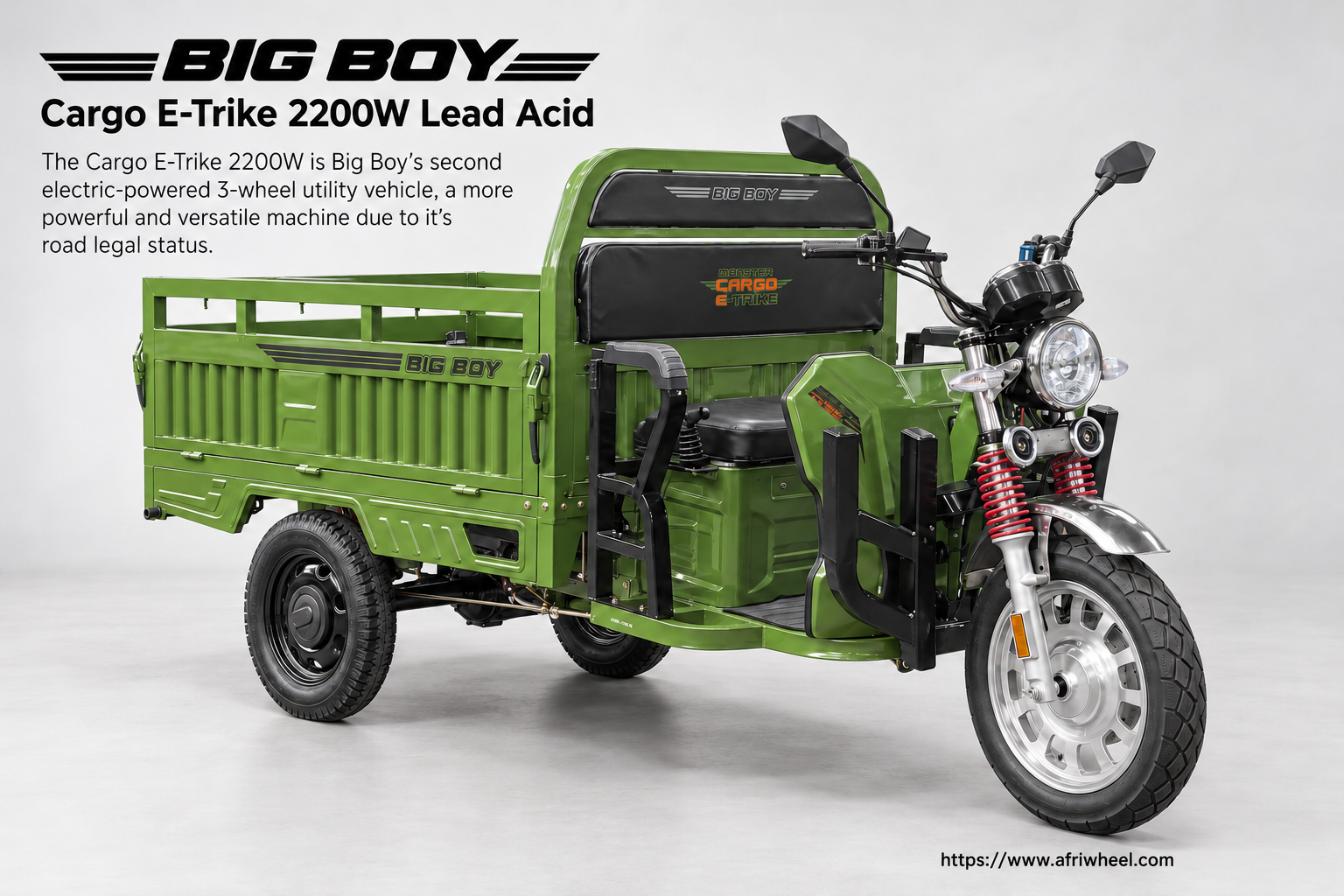
Cargo E-Trike 2200W Lead Acid buyer overview
The reason to consider Cargo E-Trike 2200W Lead Acid is its defined job: a cargo-minded option for load capacity and manoeuvrability. It is listed for South Africa in 2026 at R48,999. Start with route, rider, passenger, load and support before deciding whether it belongs on the shortlist.
Instead of a petrol tank, this model is organised around a Lead-acid battery and 2.2 kW rated motor. The local record gives 70 km claimed range, 45 km/h top speed and 61.6 Nm. Compare distance, payload and charging access before comparing motor numbers.
This model pairs Electric drive with Chain final drive and a stated 300/480-minute charge pattern. Check whether the workday allows that recovery and whether the charging point is safe and accessible.
Big Boy places this model at 1900 mm in length, 1100 mm in width and 1120 mm in height. A 1320 mm wheelbase helps explain turning space, while 780 mm seat height, 150 mm clearance and 265 kg mass shape rider confidence and recovery planning.
The road or work feel is shaped by 17-inch front and 17-inch rear wheels, 110/90-16/Rear-4.00-12/4.00-12 tyres and Disc/Drum braking. Before delivery, check markings, pressures, wheel condition, lever travel and lighting.
Use the real job to test the fit. Big Boy records 2 occupant(s) and 400 kg maximum payload, so a commercial buyer should plan restraint, route width, turning space and recovery. A road rider should consider passenger comfort and secure luggage.
Pair the 70 km claim with a daily schedule. The Lead-acid pack takes 300 minutes to 80 percent and 480 minutes to full. Check charging location, cable path, electricity supply and how payload, speed and temperature affect distance.
Use the supplied facts to make a short list, then inspect the exact stock unit. Note how it fits, turns, stops, stores cargo and charges or refuels, and who will service it.
At the showroom, check mounting height, control reach, steering lock, visibility, brake effort, tyre markings, fluid levels, fasteners and lighting. If it carries a passenger or load, reproduce that use safely.
For this record, the useful comparison line is a claimed range of 70 km. The product carries the recorded 2-person seating description and 400 kg payload value where supplied. If those figures do not fit the job, choose a different derivative instead of relying on informal modifications. Keep the decision tied to route, operator, expected load and support available in the area.
The recorded South African listing for Cargo E-Trike 2200W Lead Acid is priced at R48,999. Its atv-utility role, 2-person seating and 400 kg payload value should be read with the exact dimensions and operating limits shown above.
A price comparison only helps when the products being compared perform the same role. A small road scooter, a cargo derivative and a utility machine can sit near one another in a catalogue while carrying different limits and requiring different storage. Keep the recorded amount beside the equipment list, payload, seating, energy or fuel plan and service route. The lowest number is not automatically the most economical choice if the machine cannot complete the real duty.
Think about the full first year rather than only the purchase price. Add expected fuel or charging, tyres, brake wear, service labour, storage, transport and any practical accessories. Record who will do the work and how far that support is from the operating site. The same model can be good value for one route and poor value for another because distance, load and service access change the ownership burden.
South African ownership begins after the transaction. Before paying, ask who performs the first inspection, where routine work is done, which wear items are stocked and how a warranty claim is opened. Keep the exact model and variant name on the quotation, along with colour, equipment, price, delivery terms and any registration paperwork. This prevents a family label from being substituted for the particular machine that was discussed.
The body style sets expectations but does not answer every legal or operating question. A work vehicle may be intended for controlled property, while a road model may still need documents and equipment checked for the buyer’s use. Ask the seller to state the permitted use, seating arrangement and registration position in writing where these affect the decision. Do not infer them from a photograph or a seat shape.
Brakes and tyres deserve attention equal to the engine or motor. Confirm the tyre markings, pressure recommendations, wheel condition and brake response on delivery. For a utility product, ask how the permitted load changes stopping distance and how often the working surface damages tyres. For a road machine, make sure the rider understands the controls before carrying a passenger or adding luggage.
Every range claim or fuel figure needs context. Traffic, road speed, wind, hills, payload, tyre pressure, battery temperature and maintenance all influence the distance achieved. Use the listed value to compare the model with a close alternative, then build a route reserve rather than planning to the last kilometre or litre. A realistic weekly plan is more useful than repeating a best-case number from a product page.