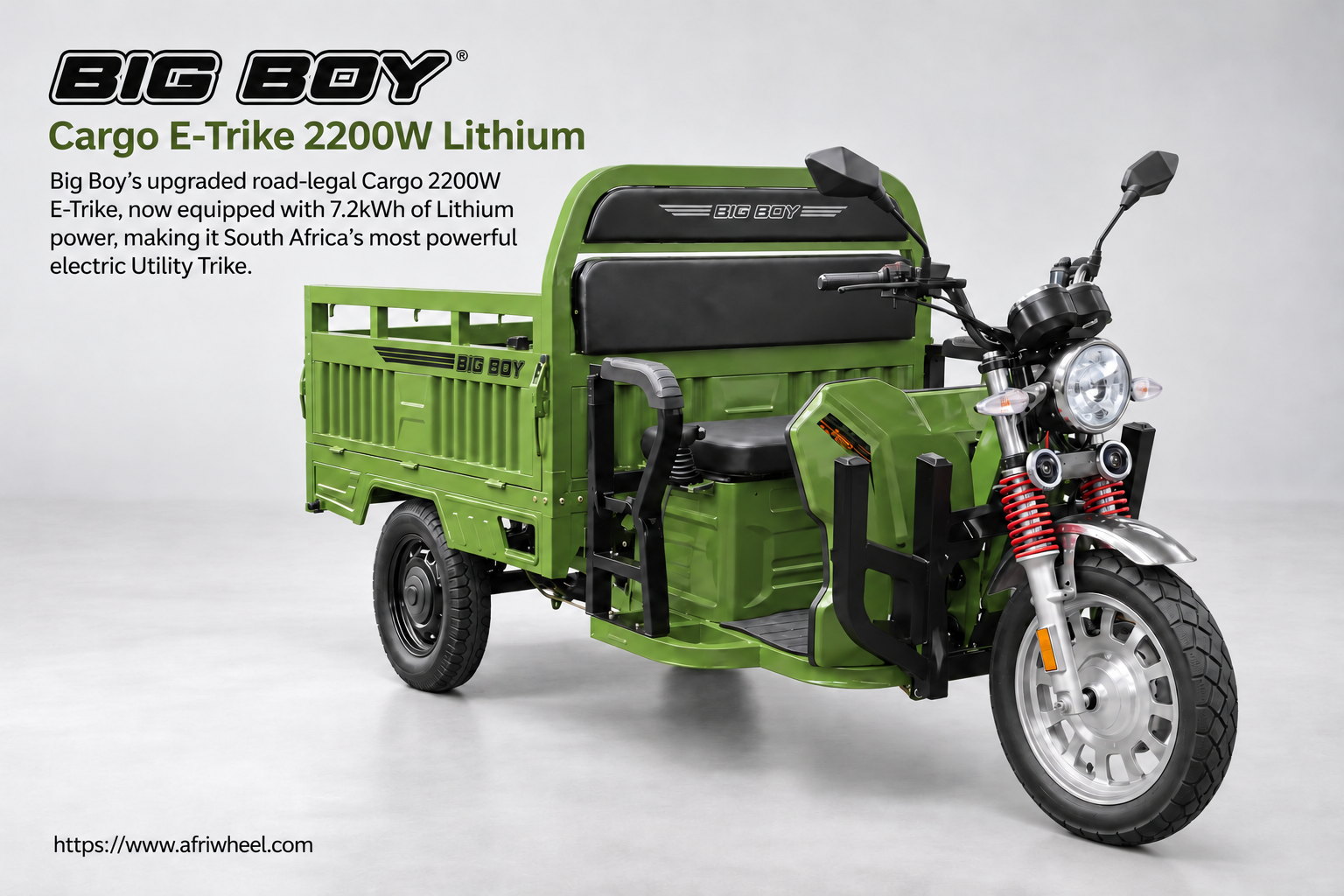
Cargo E-Trike 2200W Lithium — current South African listing buyer overview
On the local listing, Cargo E-Trike 2200W Lithium — current South African listing identifies the specific Cargo E-Trike 2200W Lithium record. The recorded amount is R52,999. That matters where a range contains cargo, commercial, electric or similarly named products with different loads, batteries, wheels or controls.
The propulsion brief is a Lithium-ion battery, 2.2 kW motor and 70 km claim. Its 45 km/h top-speed figure describes the operating envelope, while 61.6 Nm matters when considering starts, ramps and load. Real results depend on use.
Drive is electric, with Electric drive and Chain final drive. The charge window is 240 minutes to 80 percent or 360 minutes to full. Inspect the charger, plan recovery time and leave reserve rather than schedule every trip to the maximum.
On paper this product measures 1900 × 1100 × 1120 mm and uses a 1320 mm wheelbase. At 780 mm, read the seat with saddle shape and suspension compression. The listed 150 mm clearance and 265 kg mass matter on ramps, tight yards and uneven ground.
The record gives 17-inch and 17-inch wheels, 110/90-16/Rear-4.00-12 front rubber and 4.00-12 rear rubber, with Disc front and Drum rear brakes. Those details describe the equipment; a demonstration shows how it turns and stops on the buyer’s surface.
Use the real job to test the fit. Big Boy records 2 occupant(s) and 400 kg maximum payload, so a commercial buyer should plan restraint, route width, turning space and recovery. A road rider should consider passenger comfort and secure luggage.
The Lithium-ion battery changes the ownership rhythm. Big Boy quotes 70 km claimed range, 240 minutes to 80 percent and 360 minutes to full. Confirm charger storage, socket requirements, safe charging, battery terms and the reserve needed.
The reason to choose Cargo E-Trike 2200W Lithium — current South African listing should be a match between its exact equipment and the planned route or workload. Use the figures as a checklist and ask for a representative demonstration.
The purchase is ready when physical unit and paperwork agree. Inspect Cargo E-Trike 2200W Lithium — current South African listing, record its condition, verify price and support terms, and plan maintenance around the real route rather than a best-case claim.
For this record, the useful comparison line is a claimed range of 70 km. The product carries the recorded 2-person seating description and 400 kg payload value where supplied. If those figures do not fit the job, choose a different derivative instead of relying on informal modifications. Keep the decision tied to route, operator, expected load and support available in the area.
This exact Cargo E-Trike 2200W Lithium — current South African listing record is priced at R52,999. Keep its model name, powertrain, seating, payload, range or fuel figure and equipment together when comparing it with another Big Boy listing.
Service planning is part of variant selection. Note the first inspection, recurring interval, oil or filter requirements, chain or drive checks, tyre pressures and battery care instructions. Ask which tasks are time-based and which are distance-based. A variant that fits the route but cannot be supported at the required intervals will create avoidable downtime.
The derivative label is important because a single family can contain different batteries, bodies, load arrangements or commercial equipment. Keep this exact variant name on the quotation and match it to the machine on the floor. Ask the salesperson to list what is standard, what is optional and what is shown only for illustration. A small change in configuration can alter the useful range, carrying limit, service routine or delivery expectation.
A variant’s value is connected to its duty cycle. A work-focused configuration may justify a larger payload or a different body, while a commuter configuration may be easier to park and cheaper to run. State the daily job, distance, rider count and storage arrangement before choosing. If the configuration does not support that brief, changing to the correct derivative is safer than adapting it informally.
Colour and visible equipment can create confusion at handover. Confirm the exact finish, decals, racks, lights, seat, tray, battery case and charger or tools included in the price. Photograph the delivered unit and retain the invoice, manual and warranty details. That simple record makes it easier to resolve a mismatch between the variant ordered and the machine supplied.
When this derivative is compared with a nearby listing, hold the two specifications side by side. Check the powertrain, wheel and tyre combination, brake hardware, seating, payload, charger or fuel system and price. Do not borrow a figure from a sibling model simply because the names look similar. The purpose of a variant page is to make the actual buying decision precise enough for a written offer and a correct handover.
Ask the dealer to explain how the exact variant is supported after delivery. Confirm service location, first inspection, consumables, battery or charger coverage where relevant, warranty exclusions and the route for obtaining parts. Keep those answers with the written quotation. The product is ready to buy when the paperwork, displayed equipment and operator’s understanding all describe the same derivative.